
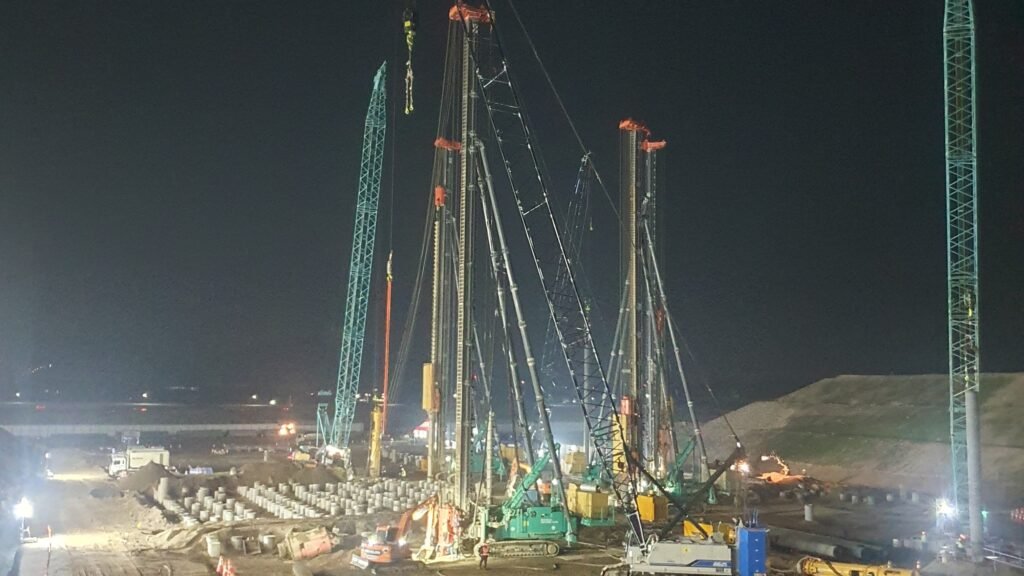
At one of the largest semiconductor fab construction sites in Korea — the Yongin cluster — thousands of PHC piles must reach firm bearing strata before a single structure rises above ground. Topdrill supplied DTH hammers and drilling tools for this foundation piling work, and the project became a good demonstration of a question we often hear from piling contractors:
“Do we really need a full-size DTH hammer for every pile?”
The answer on this site: no — and choosing the right configuration for each zone cut fuel consumption by roughly 30%.
Project Overview
- Location: Yongin, South Korea (semiconductor cluster construction)
- Work type: PHC pile installation
- Pile diameters: 500–800 mm
- Depth range: 8 m to 50 m
- Ground conditions: fill/soil, weathered rock, and soft rock
- Method: T4 (DTH hammer) drilling — standard and combination configurations
- Topdrill equipment supplied:
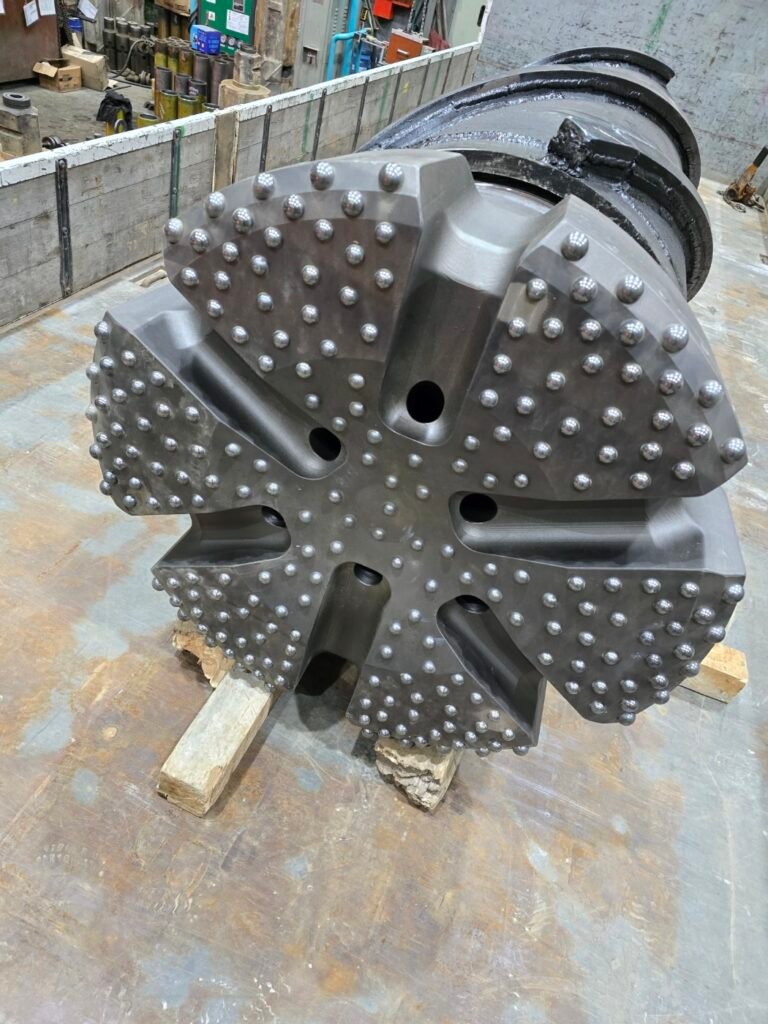
- TG640C (28″ HAMMER) with a standard 825 mm bit (standard T4)
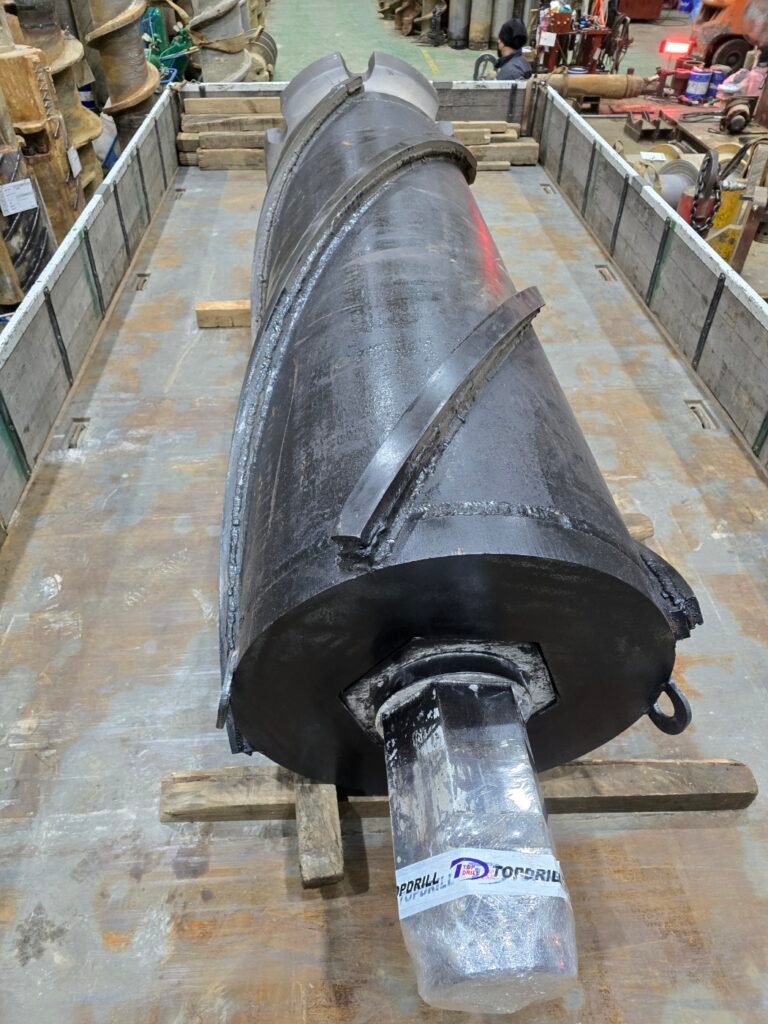
- TG120N (12″ HAMMER) with auger-tip shroud screw, OD 825 mm (combination T4)
(In the Korean piling industry, DTH hammer drilling is commonly called the “T4 method.” We use that term below.)
The Ground: Same Site, Different Requirements
Across the site, the soil profile moved from fill and soil through weathered rock into soft rock, with target depths anywhere from 8 m to 50 m. Two different design situations appeared:
Case 1 — Piles that must pass through a boulder layer and reach a fixed absolute depth.
Parts of the site contained buried boulders approaching 1 meter in diameter within the fill, and the design called for penetrating through them into soft rock regardless of what lies above. In these conditions there is no substitute for a full-size hammer. These piles were drilled with the standard T4 configuration: a Topdrill TG640C (28″) hammer drilling 825 mm holes to seat the 800 mm PHC piles, punching the full hole size through boulders, weathered rock, and soft rock to final depth.
Case 2 — Piles where design bearing capacity is achieved at the top of the weathered rock.
A large share of the piles, however, reached their required end-bearing capacity at the upper surface of the weathered rock layer. Drilling these holes with a big hammer means paying big-hammer costs for ground that mostly doesn’t need it — the heavy compressed-air demand of a large hammer, plus the price of large-diameter bits, which are among the most expensive consumables on any piling site.
The Combination T4 Setup
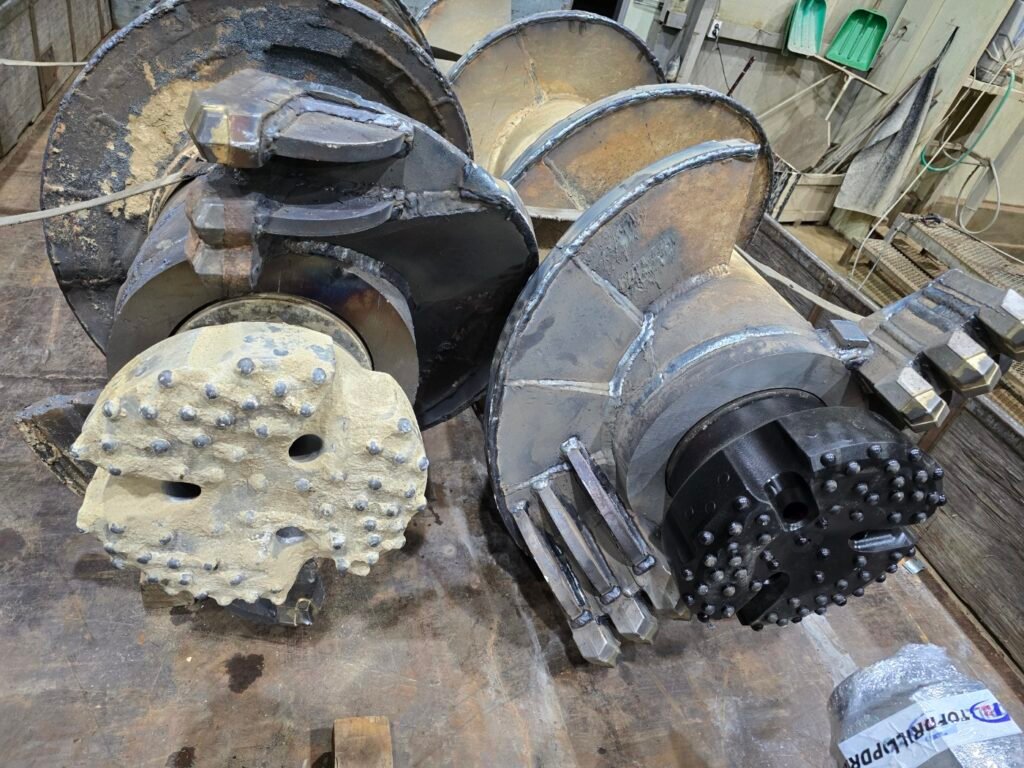
For Case 2, the contractor ran a combination T4 configuration supplied by Topdrill:
- A compact T4 hammer fitted with an auger-tip shroud screw, driven by the rig’s rotary head, drills through the soil and weathered layers — pushing smaller rocks aside as it advances.
- At the hole center, the TG120N (12″) DTH hammer delivers percussion that breaks up the harder material, making zones too hard for rotary cutting alone easy for the auger-tip screw to pass.
In other words: the small hammer’s crushing action lets the rotary head’s power work at maximum efficiency — effectively eliminating the cost a full-size hammer would consume on these piles.
One condition matters: because the auger-tip shroud relies on rotary power rather than percussion for most of the hole, the rig’s rotary head needs sufficient torque — in practice 150 HP or more.
Results
- Roughly 30% fuel savings on combination-T4 piles compared to running a full-size hammer, mainly from drastically lower compressed-air demand.
- No unnecessary wear on large hammers and bits — the TG640C fleet was reserved for the piles that genuinely required soft-rock penetration or faced large buried boulders, extending tool life across the project.
- Faster cycle times in the upper layers, since auger cutting through soil and weathered material is quicker than hammering it.
Takeaway for Piling Contractors
If your PHC pile design achieves bearing at the top of weathered rock, and your rigs carry a rotary head of 150 HP or more, a combination T4 setup — an auger-tip shroud screw plus a compact DTH hammer — can deliver the same pile quality at a significantly lower operating cost. Where the design specifies absolute depth into soft rock, or where large boulders sit in the intermediate layers, a full-size hammer such as the TG640C remains the right tool.
Topdrill manufactures both: large-diameter DTH hammers and bits up to 40 inches, and combination tooling for PHC pile work — engineered and built in Korea since 1999, and proven on projects like this one.
Planning a piling project? Tell us your rock conditions, pile diameter, and target depth — our engineers will recommend the right configuration. Visit www.topdrill.kr for our full product lineup, or contact us directly.