
Rock drill oil does two jobs inside a DTH hammer, and most crews only think about one of them. Yes, it reduces metal-to-metal friction between the piston and cylinder. But just as importantly, the oil film acts as an air seal across the running clearance — blocking pressure loss and air leakage that would otherwise rob the hammer of striking energy.
From what we see in units returned for repair, more than roughly 70% of fatal DTH hammer failures — piston seizure, thermal cracking — begin with lubrication: the wrong viscosity, insufficient feed rate, or interrupted supply. Galling, the most expensive failure on our six-cause no-strike checklist, starts here too.
Think about how strange the usual practice is. Contractors change their car’s engine oil religiously every 5,000 km — then pour recycled oil into a hammer that sometimes costs more than the car, or throttle the feed rate to save a few liters. Here is why that doesn’t work:
| Engine oil | Gear oil | Dedicated rock drill oil | |
|---|---|---|---|
| Designed for | Combustion engines — lubrication, cooling, cleaning combustion byproducts | Extreme-pressure lubrication of gear teeth | Percussion and sliding surfaces + cylinder air sealing |
| EP (extreme-pressure) additives | Limited | Strong | Sulfur-phosphorus EP package (mandatory requirement) |
| Atomization & air transport | Not designed for it | Not guaranteed | Core design requirement — carried by compressed air to the hammer |
| Metal tackiness (wash-out resistance) | Low | Moderate | High — holds its film even in wet conditions |
| Water / emulsion behavior | Poor (detergent-dispersant packages accelerate emulsification) | Limited | Water separation performance tested per ASTM D1401 |
| Use in a DTH hammer | Never | Short-term emergency only, at matching viscosity | Standard |
This guide consolidates the lubrication standards from the Topdrill technical manual into one field reference: how much to feed, when to adjust, and which viscosity to run.
1. The Base Formula: Oil Proportional to Air Flow
The standard way to set an inline lubricator is by the compressed air volume the hammer consumes. This proportional rule applies to all small and mid-size models.
Dry drilling:
0.20 L/h per 3 m³/min of air supply (or 1/3 pint per hour per 100 CFM)
Worked example: a 25 m³/min (≈900 CFM) compressor → 25 ÷ 3 × 0.20 = about 1.7 L per hour.
2. Wet Holes: Double the Feed
Wet drilling, or any drilling with foam or polymer injection:
At least double the dry-drilling rate.
The reason is simple: water and drilling foam wash the oil film off the internal surfaces faster than the lubricator replaces it (wash-out). Keep the dry-hole setting in a wet hole and the hammer is effectively running toward dry friction — even though the oiler is working.
3. Minimum Consumption by Hammer Model (Topdrill Ratings)
Air-flow math alone is not enough on large hammers. Piston weight and sliding contact area grow steeply with diameter, so the proportional calculation can fall short of what the hammer actually needs. For large-diameter models, Topdrill specifies absolute minimum consumption rates per model:
| Topdrill hammer | Dry drilling minimum | Wet / foam / water-bearing |
|---|---|---|
| TG320N/S (14″ class) | 5.0 L/h | 10.0 L/h |
| TG370N/S (16″ class) | 7.5 L/h | 15.0 L/h |
| TG450N/S (18″ class) | 10.0 L/h | 20.0 L/h |
| TG550C/CS (24″ class) | 12.5 L/h | 25.0 L/h |
| TG640C (28″ class) | 15.0 L/h | 30.0 L/h |
| TG800C (32″ class) | 24.0 L/h | 48.0 L/h |
| TG900C | 26.5 L/h | 53.0 L/h |
The key discipline is measuring actual consumption, not the dial setting. Check the lubricator tank regularly and confirm the hammer is really consuming its rated minimum in liters per hour.
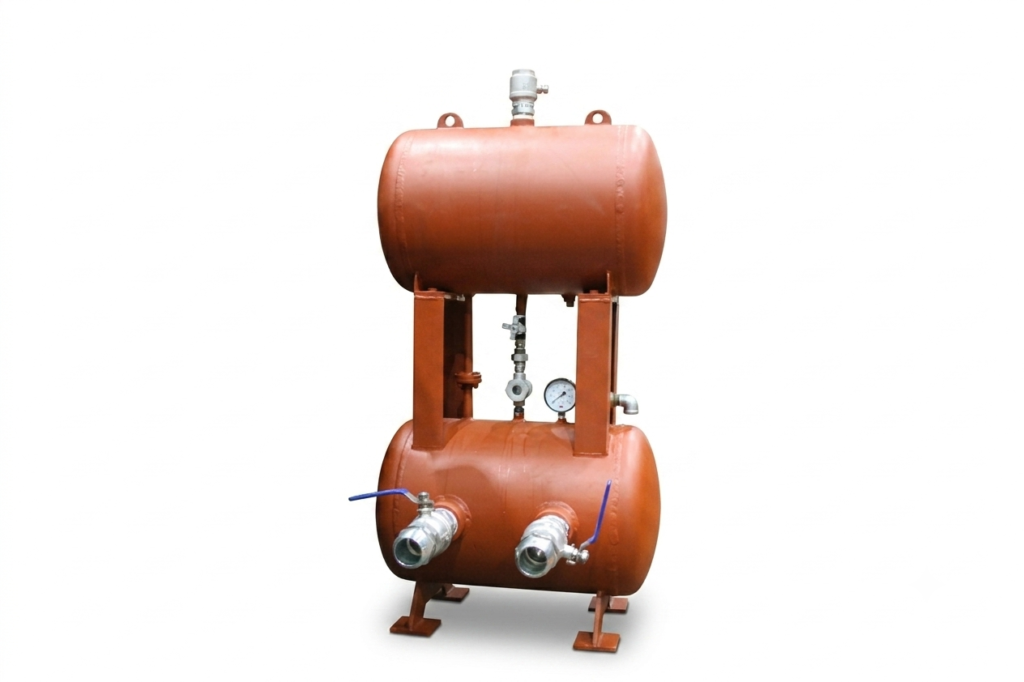
Lubricator hardware note: venturi-type oilers cannot feed high-viscosity oil reliably. With heavy grades, always use a plunger-type metering pump.
4. Three Situations Where the Proportional Rule Fails
In the following situations, the setting can look right on the gauge while the hammer starves. Always verify actual consumption directly.
① Compressor running at low flow or low pressure — reduced CFM narrows the oiler valve’s delivery, and the absolute oil quantity falls below what the friction surface area demands (starvation).
② Winter operation with long supply lines (flow lock) — in sub-zero temperatures, high-viscosity oil clings to the hose walls and is lost in transit. The gauge shows oil going in, but the hammer runs effectively dry.
③ Heavy groundwater, wet, or foam drilling — counter the wash-out by manually increasing the oiler knob to at least double, then confirm real consumption.
5. Choosing Viscosity by Temperature and Hammer Size
The right grade depends on ambient temperature and hammer size together — larger hammers load the sliding surfaces harder and need heavier oil:
| Ambient temperature | Hammer size | Recommended ISO VG | Notes |
|---|---|---|---|
| −20 °C to +15 °C (winter) | 1″ – 8″ | ISO VG 100–150 | Low-temperature fluidity, freeze prevention |
| +15 °C to +35 °C (temperate) | 10″ – 14″ | ISO VG 100–220 | Optimal range for the standard sealing film (general use) |
| Above +35 °C (hot / summer) | 14″ – 24″ | ISO VG 220–320 | Prevents film rupture at high temperature, controls cylinder leakage |
| Very hot climates & large hammers | 24″ – 40″ | ISO VG 320–1000 (Heavy to Extra Heavy) | Forced sealing of ultra-high-load interfaces; galling prevention |
Recommended rock drill oils:
- Shell Air Tool Oil S2 A series (e.g., S2 A 320)
- Xtreme™ EP Rock Drill Oils (Martin Lubricants) — ISO VG 100/150/220/320 ~ 1000
- SINOPEC Rock Drill Oil — ISO VG 100/150/220/320
If dedicated oil is genuinely unavailable: gear oil of matching viscosity may be used short-term — for large hammers, VG 320 (VG 220 minimum). But gear oil’s atomization behavior and metal tackiness are not guaranteed, so treat it strictly as an emergency measure and return to dedicated rock drill oil as soon as possible. Engine oil is never acceptable — it is formulated for a different job.
One more field rule: in hot climates like the Middle East, err toward the heavier grade. Film strength matters more than easy flow.
6. Priming: The Step Most Crews Skip
An inline lubricator does not protect the hammer at startup. It takes several minutes for atomized oil mist to travel down the string and reach the hammer internals — and those first effectively-dry minutes are the danger window. Measured data shows that within just one minute of unlubricated running, the piston–cylinder contact temperature exceeds 750 °C (1,400 °F). Repeated overheat-and-quench cycles create surface heat checks and decarburization — the starting points of piston fracture.
Before starting a shift — and always after long storage — prime the hammer manually:
Pour approximately 1.0 – 2.0 L of rock drill oil directly into the hammer through the top sub (backhead) opening, connect the string, and bring the hammer up on low pressure first.
This single habit closes the unprotected startup window entirely. It costs two liters of oil and five minutes; a galled piston costs a factory rebuild.
Protect the Hammer, Protect the Project
Lubrication discipline is the cheapest insurance in DTH drilling: set the oiler to the air flow, double it in wet holes, verify each model’s minimum consumption by actual measurement, match viscosity to climate and hammer size, and prime before startup. If you are seeing recurring wear or seizure on large-diameter hammers despite following these standards, our engineering team can help review your setup.
Topdrill has manufactured DTH hammers and bits up to 40 inches since 1999, supplying contractors in over 100 countries.
Explore our full product range: www.topdrill.kr
Technical questions: Contact us or chat with us on WhatsApp.