
Pole hole drilling for 400 kV tower and 33 kV pole foundations — Ø1,000 mm holes in 150 MPa gabbro, at 22.7 bar without a booster
At a glance
Client — a national oil company in the Middle East · oilfield power network
400 kV / 132 kV transmission tower foundations — Ø600–1,000 mm, 5–10 m deep
33 kV overhead line pole foundations — auger Ø550 / Ø800 / Ø1,000 mm, 1.5–4.8 m planting depth
Scope — several thousand pole holes · Contractors — separate packages, separate firms
Ground — wadi gravel over gabbro, UCS approx. 150 MPa
Tooling — Topdrill TG640C DTH hammer + Ø1,000 mm DTH bit / KXX Universal KXX truck-mounted drill rig
Air — Atlas Copco XRV 1200 × 3 @ 22.7 bar (330 psi), no booster
Period — 2024 ~ 2026
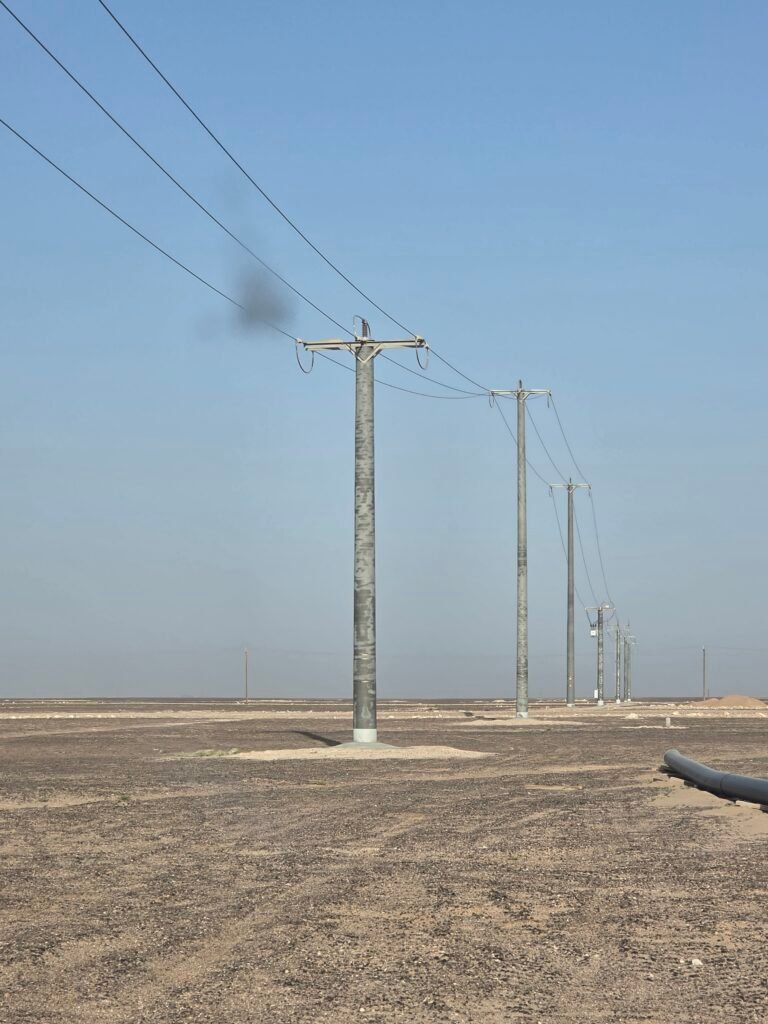
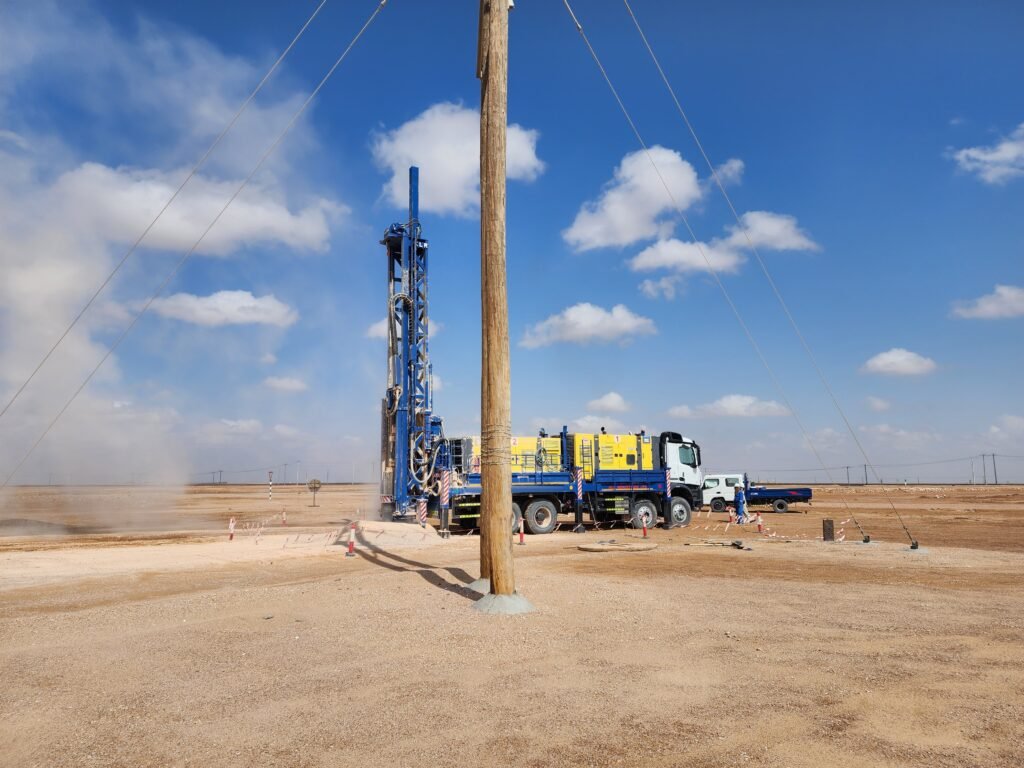
From wooden utility poles to concrete utility poles
1. On an oilfield, the power network is a foundation job
An oil field does not run on wells alone. Pumps, gathering stations, processing plant, camps — everything scattered across the desert needs power, and that power arrives on overhead lines. A large share of oilfield infrastructure work is, in practice, foundation work.
This network has two tiers: lattice towers carrying the 400 kV and 132 kV backbone, and spun concrete poles carrying 33 kV distribution. Different structures, but from a construction standpoint the same problem — a large hole, in hard ground, several thousand times. Both tiers came down to the same operation: pole hole drilling through rock, at volume.
And the alignment is not chosen for its geology. It is chosen by where the wells and facilities are. Whatever is under the ground, the line goes there. In this part of the Middle East, that “whatever” is frequently hard rock.
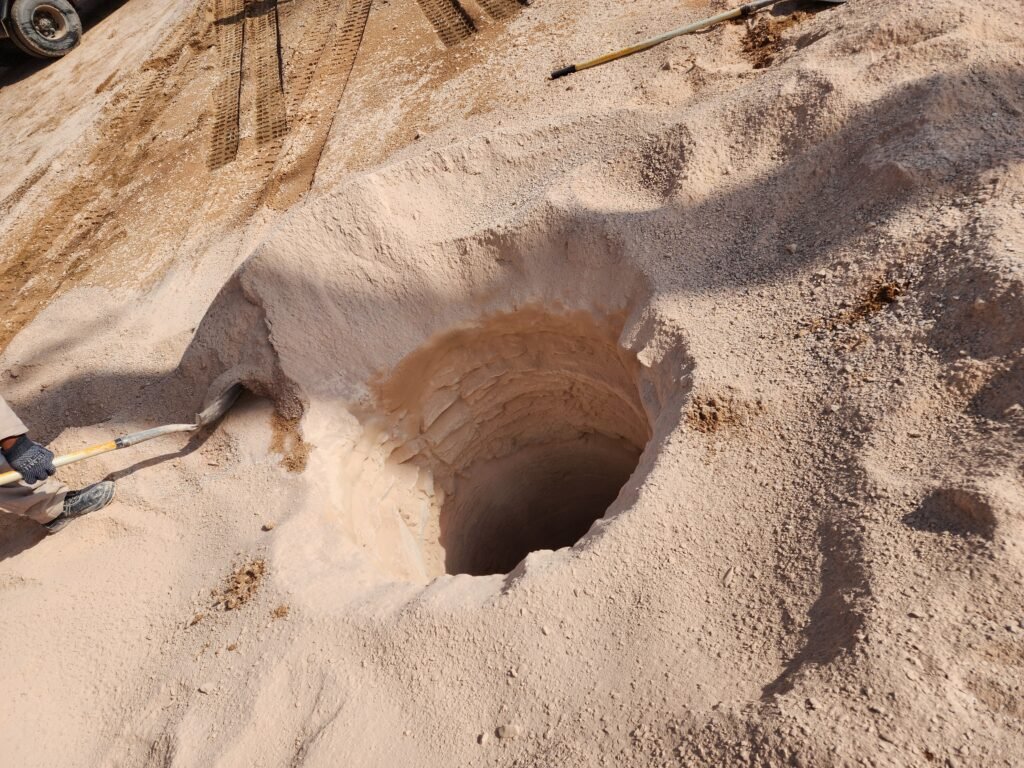
The section here is wadi gravel overburden over gabbro, UCS approximately 150 MPa — hard, and more to the point abrasive.
2. What the client’s own standard says: hard rock is the favourable condition
The operator’s 33 kV overhead line foundation standard grades the ground into four classes and assigns each an allowable bearing capacity:
| Ground class | Allowable bearing capacity |
| Loose soil | 200 kN/m² |
| Medium dense | 350 kN/m² |
| Dense | 500 kN/m² |
| Hard rock | 2,100 kN/m² |
Hard rock carries more than ten times what loose soil carries. So the standard permits a shallower planting depth in rock:
| Pole type | Loose soil | Hard rock | Difference |
| I(11) 11 m intermediate | 2,000–2,600 mm | 1,500 mm | up to 1,100 mm |
| A/S(12) 12 m angle/section | 3,000 mm | 2,500 mm | 500 mm |
| T(16) 16 m terminal | 4,000 mm | 2,500 mm | 1,500 mm |
| Td/ATd(16) 16 m | 4,800 mm | 3,400 mm | 1,400 mm |
On a terminal pole that is 1.5 m less hole per foundation — and correspondingly less backfill. On paper, rock is the condition you want.
Then comes the part that decides the programme.
The excavation tool the same standard assumes is an auger, Ø550 / Ø800 / Ø1,000 mm. And the very rock that shortens the hole sits beyond what an auger’s cutting teeth can shear.
So the rock sections are favourable by design and unreachable by the assumed method. That gap is exactly where a large-diameter DTH hammer earns its place — and on the 400 kV / 132 kV transmission tower foundation package, where holes run 5 to 10 m deep, the same gap repeats at a larger scale.
The standard is already worried about time.
Its notes open one clause with: “To reduce foundation installation time, the following alternative methods may be used in consultation with the civil construction team.” What follows is permission to use tripod supports so the crane need not wait on concrete, and — subject to approval — a site-mixed C20 with self-compacting additives.
Schedule compression is not our argument. It is already the client’s.
Another note requires surveying equipment to align and check verticality during installation. That single line is why hole diameter and plumb are not “close enough” items.
3. The configuration: TG640C DTH hammer with a Ø1,000 mm bit
Hammer and bit: Topdrill TG640C DTH hammer with a Ø1,000 mm DTH bit.
A down-the-hole hammer delivers percussive energy at the bit face, not down the drill string. That makes 150 MPa gabbro a normal working condition rather than a refusal, and it makes penetration rate largely independent of hole depth — which is why one hammer covers both a 1.5 m pole foundation and a 10 m tower foundation.
Diameter and verticality follow from tool geometry as much as from operator skill: the standard’s dimensions and plumb tolerance have to be repeatable across several thousand holes.
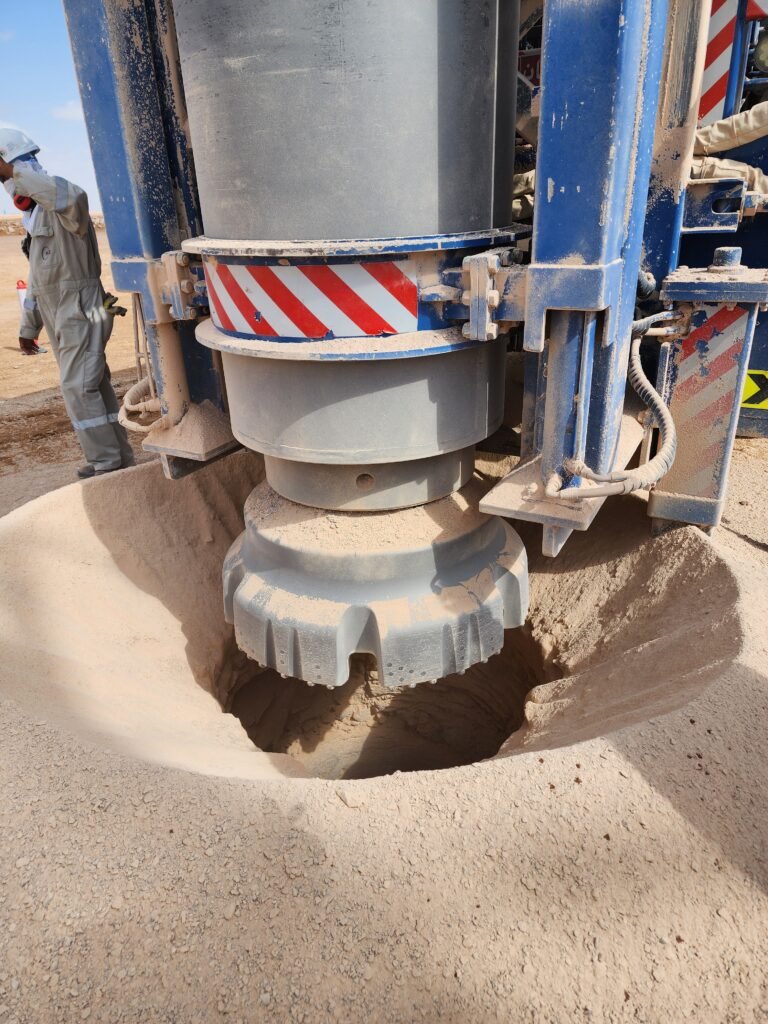
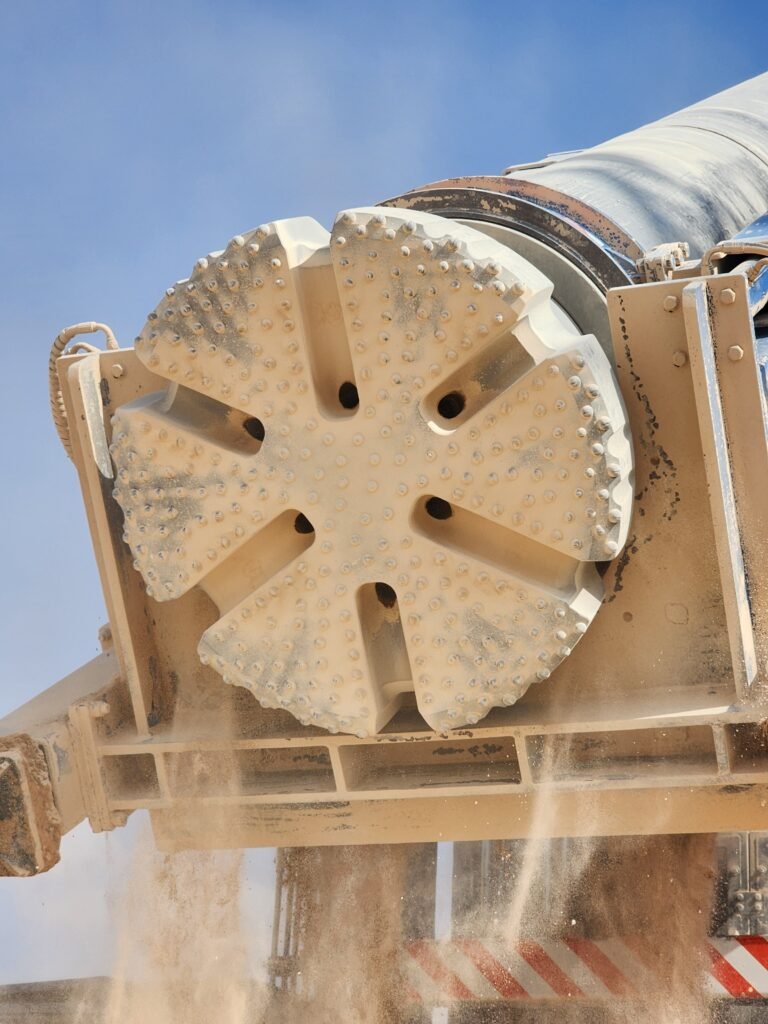
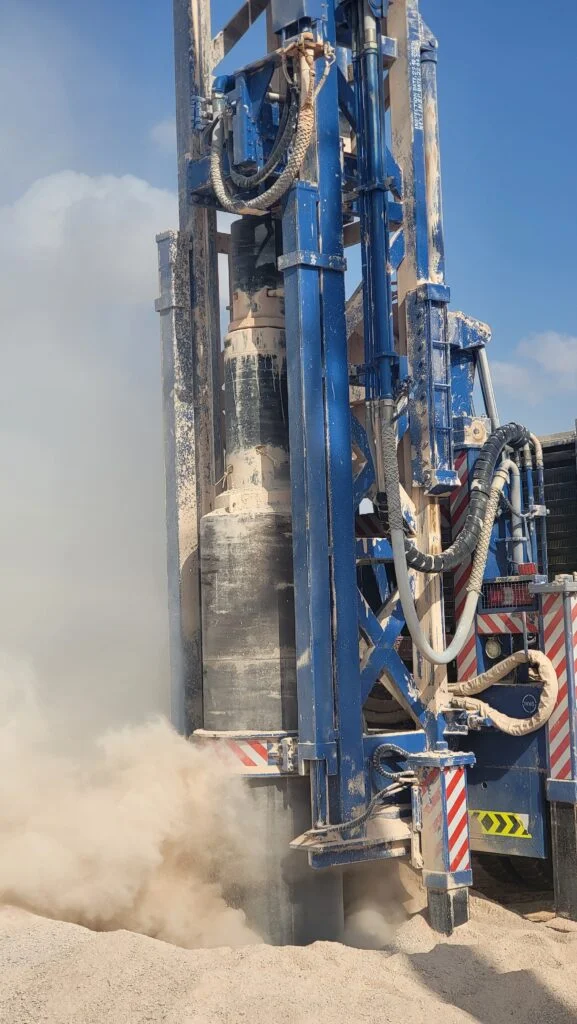
Rig: Kxx Universal Kxx truck-mounted drill rig.
Air: Atlas Copco XRV 1200 × 3, 22.7 bar (330 psi), no booster.
This is the part of the reference worth pausing on. Ø1,000 mm pole holes were drilled without a booster, on standard 22.7 bar high-pressure compressors.
Air package size is the first thing that gives a contractor pause about large-diameter DTH. A booster adds units, adds mobilisation logistics, adds fuel, adds maintenance. On an oilfield the alignment is long and the supply route is longer — one more machine on the spread is more than a line on the hire schedule.
Getting there means the hammer has to deliver its full blow within the pressure a standard package provides. Which is the same rule stated in reverse: hammer selection follows the compressor you can actually get to site, not the one in the catalogue.
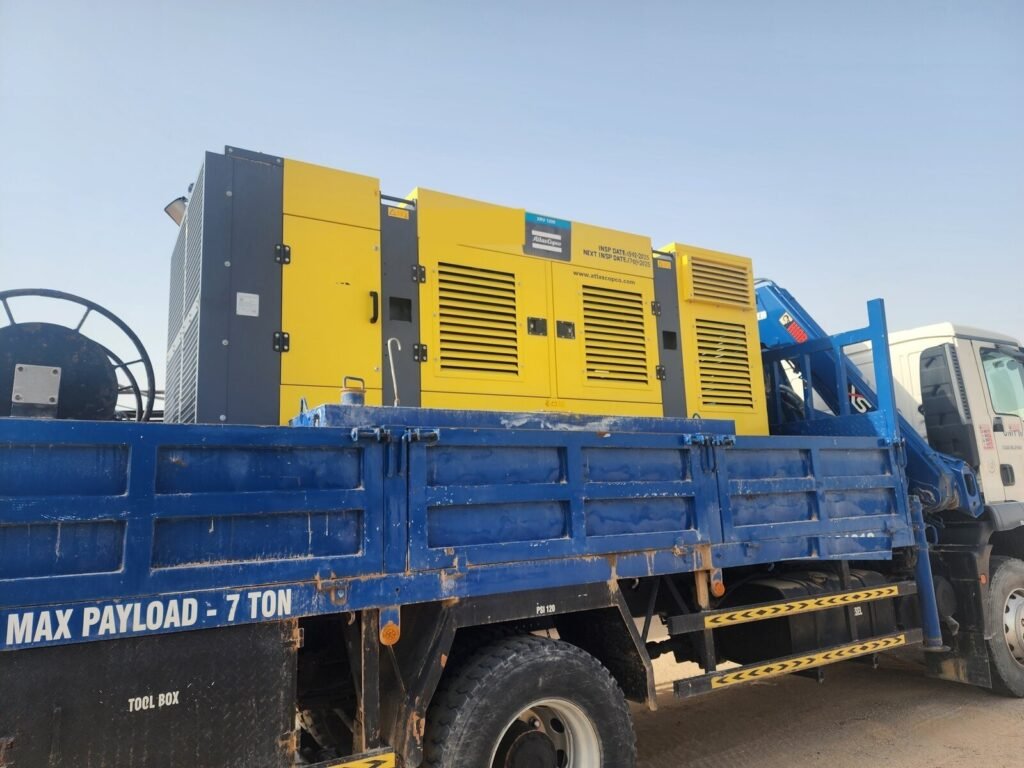
Caption: Atlas Copco XRV 1200 compressors at 22.7 bar. Ø1,000 mm without a booster.
4. What the site showed
First, penetration rate held across both the gabbro and the wadi material. For a pole hole drilling programme of this size, that is the finding that matters. The cycle did not collapse at the overburden-to-rock transition, and daily output settled into a predictable band. On a several-thousand-hole programme, predictability matters as much as speed — it is what makes a programme schedule possible.
Second, the same configuration was adopted by two different contractors. This network was tendered in separate voltage packages: one firm took the 400 kV / 132 kV tower works, another took the 33 kV pole works. Both independently ran the same hammer and bit.
Tool selection is the contractor’s own call. Two different organisations reaching the same conclusion on the same ground says the choice was made on observed results rather than catalogue figures.
5. What penetration rate buys is days, not metres
Quoting penetration rate in m/hr tells half the story. On a several-thousand-hole pole hole drilling programme, the working unit of penetration rate is the day.
Put it in numbers. The table below is not this project’s record — it is a worked example showing how penetration rate behaves in a programme schedule. Assume a 2,000-hole package:
| Holes per day (assumed) | Working days for 2,000 holes |
| 20 | 100 |
| 30 | 67 |
| 40 | 50 |
| 50 | 40 |
Lifting daily output from 20 to 30 holes removes 33 days; from 30 to 40, another 17.
And attached to those days is everything else:
- rig and ancillary equipment hire (or depreciation)
- crew wages and subsistence
- camp running cost, support vehicles, fuel
- supervision and management staff
- insurance and site overheads
- and, on a programme with a completion deadline, exposure to liquidated damages
You can switch off a compressor. You cannot switch off a day.
Shutting compressors down during idle time is exactly what a well-run site does, and it works. But crew wages, the camp, the rig and the supervision team have no off switch. As long as the site is open, those costs run every single day.
So the value of penetration rate on a pole hole programme is not fuel saved. It is the number of days the site stays open.
Do the arithmetic with your own rates:
(rig + crew + camp + supervision, per day) × days removed, at your own scope and rates.
Then put that figure next to the price of a hammer and a bit.
(Fuel drops too. Whether the compressors run continuously or are shut down when idle, fewer compressor-hours per hole means less fuel per hole. It is simply the smallest item on the list above.)
6. Reliability: holding on to the days you saved
If penetration rate is what removes days, reliability is what stops them coming back. On a large-diameter site the second matters as much as the first.
The reason is the unit of recovery time.
On a small-diameter site the spare bit is in the truck and a change takes hours. A Ø1,000 mm bit weighs 4–5 tonnes. With no spare on site, freighting one from Korea means:
USD 20,000–30,000 in air freight alone. Roughly two weeks of lead time.
We have run the same Ø1,000 mm class from a barge in a tidal channel, where the tolerance was 15 mm — offshore piling at Jindo, Korea.
On large diameter, one unplanned stop is not a one-day problem; it spreads into weeks — and the longer the supply route into a desert oilfield, the wider that gap opens.
Which is why what a large-diameter hammer owes you is not peak performance but predictable performance: wear you can see coming, and replace on your own schedule rather than the airline’s.
Wear can be managed. Breakage cannot. That is the design target.
7. Large sizes leave no room
The first line on our homepage reads:
“No Room for Uncertainty.”
Large-diameter drilling leaves no room for uncertainty.
Before it is a slogan, it is the two calculations above put together.
A 3-inch hammer down for a day and a 40-inch hammer down for a day are not proportional events. On a small-diameter site the spare is close by and the loss is measured in hours; on a large-diameter site the spare weighs four tonnes and the loss is measured in weeks. As diameter grows, the price of uncertainty grows a great deal faster than the diameter does.
A large hammer is not a small hammer scaled up. Building a 40-inch hammer is a different engineering problem from enlarging a small model in proportion — and where that difference shows is not in a catalogue, but in a programme schedule like this one.
FAQ
What is pole hole drilling?
Drilling large-diameter vertical holes for the foundations of slender structures — transmission towers, utility poles and similar. On this project the holes ran Ø550–Ø1,000 mm and 1.5–10 m deep, repeated several thousand times along the alignments. The governing constraint is cycle time across the whole scope, not depth on any one hole.
Where are large-diameter DTH hammers used on an oilfield?
The largest volume is the power network — transmission tower and pole foundations for the overhead lines linking wells, gathering stations, processing facilities and camps. Beyond that: large-diameter pile foundations for plant structures, and water wells for camp and process supply. The common thread is always the same — hard rock, large diameter, and the same operation repeated.
Isn’t hard rock actually the easier condition?
By design, yes. On this project’s governing standard, hard rock is rated at 2,100 kN/m² against 200 kN/m² for loose soil, and the planting depth shortens accordingly — up to 1.5 m less on a terminal pole. But realising that shallower hole means drilling the rock. An auger, which is what the standard assumes, refuses in these sections. That gap between the design advantage and the buildable method is the whole problem.
The planting depth is under 2 m. Is a DTH hammer really necessary?
Depth is not the criterion; rock strength and diameter are. With 150 MPa gabbro inside those 1.5 metres and a Ø1,000 mm hole to make, what is required is not reach but the ability to cut a large section in hard rock at a consistent rate. A DTH hammer delivers energy at the bit face, so rate holds regardless of how shallow the hole is.
How much compressor capacity does a Ø1,000 mm pole hole need?
It depends on hammer size and working pressure. This project ran three Atlas Copco XRV 1200 high-pressure compressors at 22.7 bar, with no booster. Send us the hammer size and hole schedule and we will state the required cfm and bar.
Can DTH handle collapsing overburden?
Not on its own. Wadi gravel and alluvium need an overburden casing system or casing advancement to keep the hole open until the hammer reaches competent rock.
How long does it take to air-freight a large-diameter bit?
A Ø1,000 mm bit weighs 4–5 tonnes. Air freight alone runs USD 20,000–30,000, with roughly two weeks of lead time. On large-diameter sites we recommend pre-positioning spares for that reason.
Close / CTA
Topdrill has manufactured large-diameter DTH hammers and bits in Korea since 1999 and supplies roughly 100 countries. Oilfield power network foundations — tower and pole — along with large-diameter pile foundations and water wells are our core applications wherever rock has to be drilled at scale. The Middle East is among our principal markets.
Large-diameter drilling leaves no room for uncertainty. If you have a pole hole drilling or transmission tower foundation programme coming up, send us the borelog, the hole schedule, the compressor package you can actually get to site, and your target holes per day. We will tell you what we would run — and what we would not.